Business Central 2026 Wave 1 Introduces Native Subcontracting Management for Manufacturing
Manufacturing companies have been waiting for this capability for years.
One of the biggest challenges in manufacturing implementations within Microsoft Dynamics 365 Business Central has always been handling subcontracting processes in a structured and traceable way. While Business Central has provided strong production and inventory management features, organizations heavily dependent on outsourced production operations often had to rely on customizations, ISV solutions, or manual processes to manage subcontracting activities efficiently.
With Business Central 2026 Release Wave 1 (Version 28), Microsoft has finally introduced native subcontracting management directly inside the manufacturing process.
This enhancement is a major milestone for manufacturing organizations that outsource operations such as heat treatment, coating, assembly, packaging, surface finishing, machining, and external processing.
Why This Enhancement Matters
In real-world manufacturing environments, many companies outsource a significant percentage of their production operations to third-party vendors. These subcontractors may perform specialized manufacturing activities before returning the finished or semi-finished goods back to the organization.
Previously, handling this process in Business Central required several workarounds:
- Manual purchase order creation
- Separate inventory transfer tracking
- External costing adjustments
- Limited item traceability
- Difficult warehouse coordination
- Custom extensions for subcontract management
This often created operational complexity and reduced visibility across the production lifecycle.
Microsoft has now addressed these gaps with a fully integrated subcontracting framework.
Native Subcontracting in Business Central 2026 Wave 1
The new functionality enables organizations to manage outsourced production operations directly from Production Orders while maintaining inventory control, costing accuracy, warehouse tracking, and vendor visibility throughout the process.
The entire subcontracting lifecycle is now connected within the standard manufacturing workflow.
Generate Subcontracting Purchase Orders from Production Orders
One of the biggest improvements is the ability to generate subcontracting purchase orders directly from Production Orders.
When a routing operation is marked as Subcontracted and assigned to a vendor, Business Central automatically enables the Create Subcontracting Orders action.
This process automatically creates a linked Purchase Order containing:
- Vendor details
- Item information
- Quantities
- Expected receipt dates
- Pricing details
- Production Order linkage
This eliminates the need for manual subcontract purchase order creation and significantly improves process efficiency.
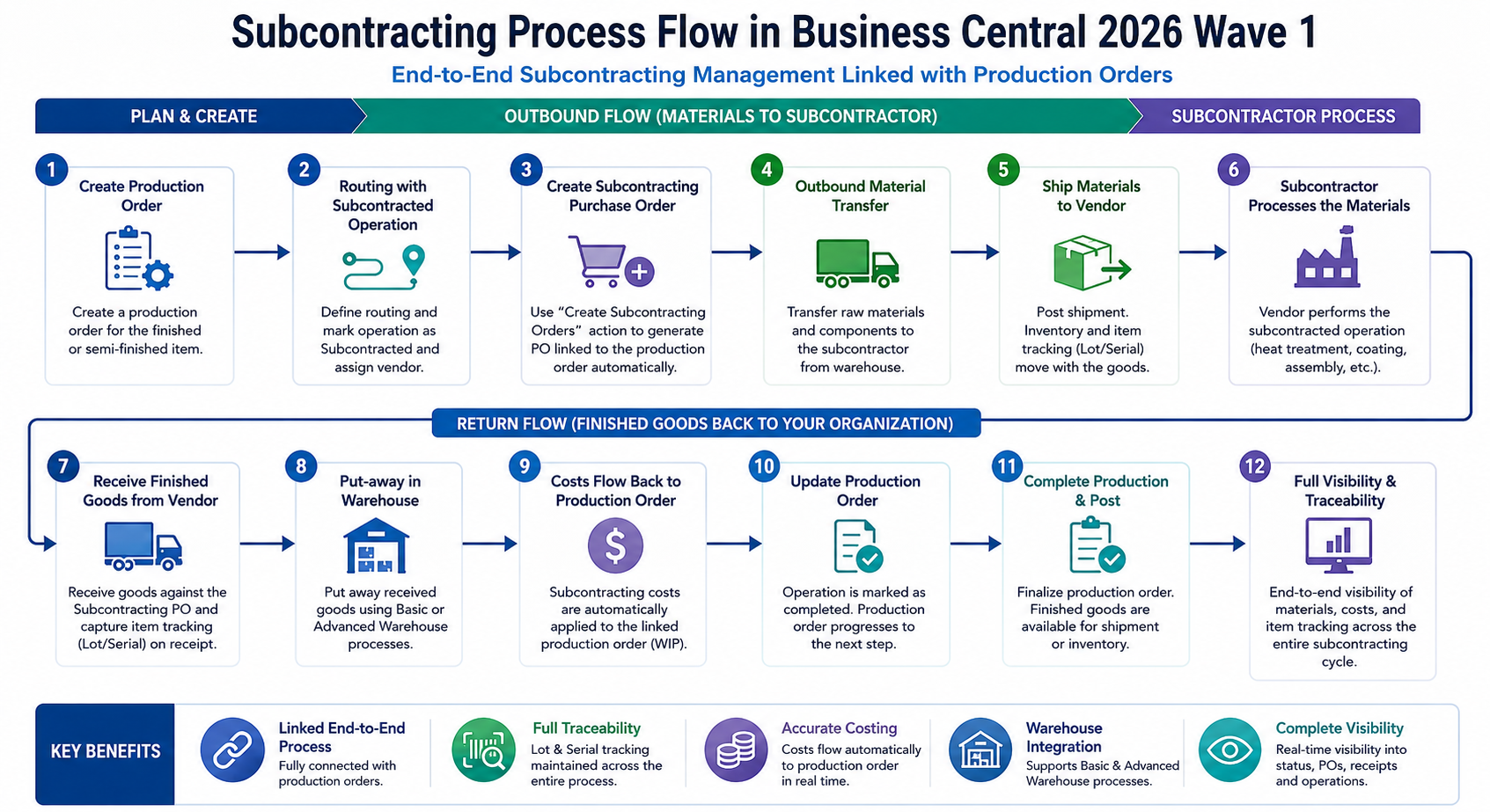
Structured Logistics Flow for Material Transfers
Before this release, transferring raw materials to subcontractors was often managed manually through transfer orders or inventory journals.
Business Central 2026 Wave 1 now introduces proper logistics support for subcontracting scenarios.
Organizations can now manage:
- Outbound transfer of raw materials
- Component shipment tracking
- Warehouse handling processes
- Inventory movement visibility
- Material consumption control
This ensures complete operational traceability when inventory leaves the organization for external processing.
Complete Lot and Serial Number Traceability
For industries such as pharmaceutical, food manufacturing, automotive, aerospace, and medical equipment, item traceability is critical.
One of the strongest additions in this release is the ability to maintain Lot Number and Serial Number tracking throughout the subcontracting process.
Traceability is now maintained across:
- Outbound material transfers
- Subcontracting Purchase Orders
- Vendor processing
- Inbound finished goods receipts
This creates a complete audit trail and strengthens compliance management for regulated industries.
Automatic Cost Flow Back to Production Orders
Cost tracking has traditionally been one of the most difficult areas in subcontracting management.
In previous implementations, organizations often performed manual cost adjustments or reconciliations after receiving subcontracted goods.
With the new enhancement, subcontracting costs now automatically flow back into the related Production Order and Work In Progress (WIP).
This provides:
- Real-time production costing
- Accurate WIP valuation
- Reduced manual reconciliation
- Improved financial visibility
- Better manufacturing profitability analysis
This enhancement significantly improves manufacturing accounting accuracy inside Business Central.
Flexible Subcontract Pricing Management
Business Central now supports dedicated subcontract pricing structures.
Organizations can define pricing based on:
- Work Center
- Item Number
- Vendor
- Quantity
- Effective date range
During Purchase Order generation, the system automatically selects the appropriate subcontract pricing configuration.
This helps organizations standardize vendor pricing agreements and reduce manual pricing errors.
Warehouse Integration for Subcontracting
Warehouse management is now fully integrated with subcontracting processes.
Both Basic Warehouse and Advanced Warehouse configurations are supported.
The system can now manage:
- Pick activities
- Shipment processing
- Put-away activities
- Directed warehouse movements
- Bin management
- Receipt handling
This creates a seamless operational flow between production, warehouse, and subcontracting operations.
Enhanced Visibility on Production Orders
Production planners and operations teams now gain significantly improved visibility into subcontracted operations.
Production Orders can display:
- Subcontracted routing operations
- Linked subcontracting purchase orders
- Pending vendor receipts
- Completion status
- Inventory movement tracking
This provides a centralized operational view and improves production planning efficiency.
Real Business Impact for Manufacturing Companies
This enhancement is especially valuable for organizations that:
- Outsource production activities
- Work with external processing vendors
- Require lot and serial traceability
- Need accurate subcontract costing
- Operate complex warehouse environments
- Manage multi-stage production operations
The new functionality reduces dependency on third-party solutions while improving operational control and transparency.
Final Thoughts
The introduction of native subcontracting management in Microsoft Dynamics 365 Business Central is one of the most impactful manufacturing enhancements delivered in recent Business Central releases.
Microsoft has transformed subcontracting from a workaround-driven process into a fully integrated manufacturing capability.
General Availability
Business Central 2026 Release Wave 1
Version 28 | June 2026


