In the age of AI, the real challenge for most organizations is moving from isolated pilots to repeatable, governed, and scalable outcomes. Microsoft’s AI Adoption Framework provides a solid foundation for defining an AI strategy, but many teams still struggle with one critical question:
How do we actually build and scale AI solutions across the business using low code and pro code approaches?
This post bridges that gap by translating the AI Adoption Framework into practical guidance, with a strong focus on low code execution and a high level view of where pro code fits.
Refer to Microsoft AI Adoption Strategy documented here in detail - Create your AI strategy - Cloud Adoption Framework
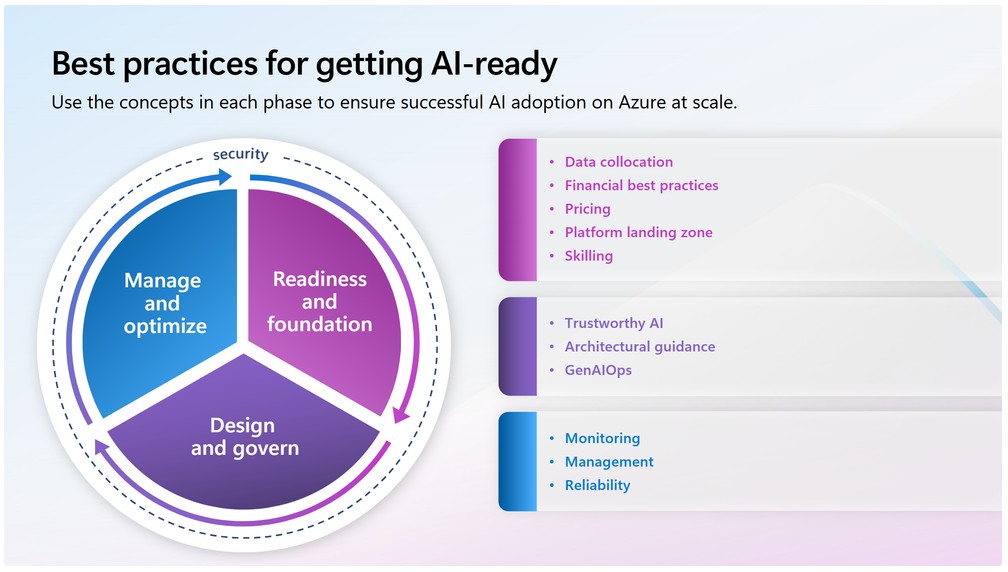
Why AI Strategy Comes Before AI Solutions
One of the strongest messages in the AI Adoption Framework is that AI success is driven by intent, not technology. Organizations that start with models or tools often end up with impressive demos but limited business impact.
An effective AI strategy begins by answering a few foundational questions:
- What business problems are we trying to solve?
- Where can AI improve speed, quality, or decision making?
- How will we measure success and scale responsibly?
This mindset shifts AI from a technical experiment to a business capability. It also sets the stage for deciding when low code is sufficient and when pro code is required.
Data as the Backbone of AI Adoption
No AI strategy survives without a strong data foundation. The framework emphasizes data readiness because AI systems are only as reliable as the data they consume.
From a practical perspective, this means ensuring:
- Data is discoverable, trusted, and governed
- Security and compliance are built into data access
- Lineage and ownership are clearly defined
- Data can be reused across multiple AI solutions
Low code platforms often expose data through connectors and abstractions, which accelerates development. Pro code solutions typically manage data pipelines directly, offering greater control. A mature AI strategy allows both, while enforcing consistent governance across each approach.
Low Code as the Fastest Path to AI Value
Low code plays a critical role in AI adoption because it lowers the barrier to entry. Business teams and domain experts can participate directly in solution creation without waiting for scarce engineering resources.
Low code AI solutions are especially effective for:
- Internal productivity assistants
- Workflow automation with embedded intelligence
- Decision support tools based on existing enterprise data
- Rapid experimentation and validation of AI use cases
The real strategic advantage of low code is speed to learning. Organizations can validate whether an AI idea delivers value before investing in deeper engineering efforts. However, low code success depends on guardrails. Without governance, it can lead to fragmented solutions and inconsistent behavior. The AI Adoption Framework reinforces that enablement must go hand in hand with oversight.
Where Pro Code Fits in an AI Strategy
Pro code remains essential for scenarios that demand precision, scale, or deep customization.
This typically includes:
- Custom model training and fine tuning
- Advanced integration with legacy systems
- Performance sensitive or mission critical workloads
- Complex orchestration across multiple services
From a strategy perspective, pro code should not replace low code. Instead, it should complement it. Many successful organizations use low code to define experiences and workflows while relying on pro code services behind the scenes to handle complexity. This separation of concerns allows teams to innovate quickly without compromising architectural integrity.
The Hybrid Model: Low Code and Pro Code Together
The most effective AI strategies rarely choose one approach exclusively. Instead, they adopt a layered model.
For example:
- Low code is used to build AI powered agents and user experiences
- Pro code services handle data processing, model orchestration, and integration
- Governance and security are enforced consistently across both layers
This hybrid approach aligns closely with the AI Adoption Framework’s emphasis on scale, responsibility, and continuous improvement.
Responsible AI and Governance as Design Principles
AI governance is not a final step. It is a design principle that must be embedded from the start.
A strong AI strategy includes:
- Clear accountability for AI decisions
- Transparency into data sources and outputs
- Monitoring for quality, bias, and drift
- Controls that scale across low code and pro code solutions
When governance is built into platforms and processes, teams can innovate confidently rather than cautiously.
From Framework to Execution
The AI Adoption Framework provides direction, but execution determines outcomes. The real differentiator is not whether an organization uses low code or pro code, but how intentionally those tools are applied.
Low code accelerates adoption and democratizes innovation.
Pro code enables depth, scale, and control.
Together, they form a practical, resilient AI strategy.
Organizations that embrace this balance move faster, learn quicker, and scale AI with confidence.


