







XML response from OData services
 Martin Dráb
 237,878
Most Valuable Professional
237,878
Most Valuable Professional
 Like
Like Share
Share
 Report
If you call OData services in AX 7 (Dynamics 365 for Finance and Operations), you typically get data in JSON format, like this:
{
  "@odata.context":"https://myaxinstance.cloudax.dynamics.com/data/$metadata","value":[
    {
      "name":"ElectronicPaymentTypes","kind":"EntitySet","url":"ElectronicPaymentTypes"
    },{
      "name":"ExpensePaymentDetails","kind":"EntitySet","url":"ExpensePaymentDetails"
    }
    ...
  ]
}
JSON is a simple, lightweight format with good support in many tools, but sometimes you would rather get XML. XML is by no mean deprecated – it’s more than a format; you get a whole platform with capabilities useful for validations (XML schema), querying (XPath, XQuery), transformations (XSLT) and so on. Or you simply have a component that accepts only XML and not JSON.
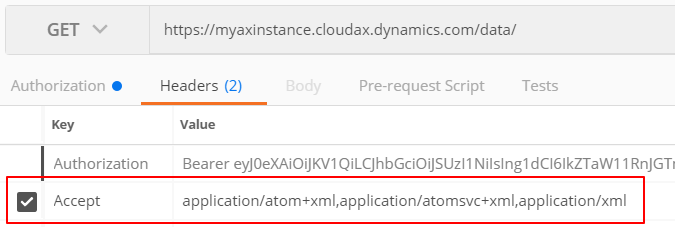
Fortunately OData services aren’t limited to JSON; they can return XML as well. Simply add HTTP header Accept with value application/atom+xml,application/atomsvc+xml,application/xml and you’ll start getting the same data in XML format:
<ODataServiceDocument xmlns:i="http://www.w3.org/2001/XMLSchema-instance"
xmlns="http://schemas.datacontract.org/2004/07/Microsoft.OData.Core">
  <EntitySets>
    <ODataEntitySetInfo>
      <Name>ElectronicPaymentTypes</Name>
      <Title i:nil="true" />
      <Url>ElectronicPaymentTypes</Url>
    </ODataEntitySetInfo>
    <ODataEntitySetInfo>
      <Name>ExpensePaymentDetails</Name>
      <Title i:nil="true" />
      <Url>ExpensePaymentDetails</Url>
    </ODataEntitySetInfo><ODataEntitySetInfo>
  ...
  </EntitySets>
</ODataServiceDocument>
If you use Postman, for example, this is where you can put the header:
 Of course, that you get XML format doesn’t mean that you get the structure you want. You still may need to transform it to something more suitable for your purposes.
This was originally posted here.
*This post is locked for comments