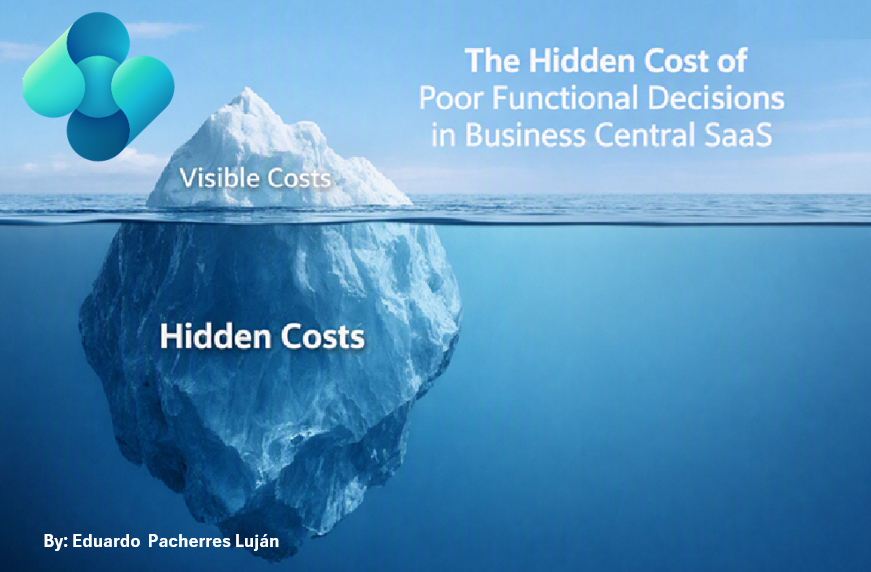
Poor functional decisions in Business Central SaaS rarely show their impact on the day they are made.
They show up later—when the system is already in production, users depend on it, and correcting the damage costs far more than doing things properly from the start.
This is not a technical post.
It is a practical reflection on how small functional choices can create large operational, financial and organisational consequences.
1. When a functional change looks small… but isn’t
Some decisions seem harmless:
Business Central does not forgive improvisation.
Real case
A retail company enabled bin tracking because “the warehouse manager wanted more control”.
No impact assessment.
No process review.
No sandbox testing.
Three weeks later:
picking slowed down,
warehouse staff were confused,
orders were delayed,
inventory became unreliable,
finance received inconsistent valuations.
The hidden cost wasn’t the configuration.
It was lost productivity, frustrated staff, and a decline in service quality.
A junior consultant sees the screen.
A senior consultant sees the consequences.
2. The cost of creating data without purpose
Business Central makes it easy to create fields, tables and automations.
But ease can become a trap.
Real case
A team created custom fields to “improve sales control”.
No one defined:
who would use them,
what they were for,
how they would be validated,
which process supported them,
how they affected reporting.
Result:
The hidden cost wasn’t the field.
It was the loss of trust in the ERP.
A junior consultant creates fields.
A senior consultant avoids them.
3. The cost of misunderstanding accounting impact
Functional decisions always end up in finance.
Always.
Real case
A user changed VAT settings because “a supplier asked for it”.
No impact review.
No historical analysis.
No validation with accounting.
Result:
The hidden cost wasn’t the change.
It was the correction, the audit, the wasted time, and the compliance exposure.
A junior consultant looks at the screen.
A senior consultant thinks about month-end closing.
4. The cost of allowing functional exceptions
Exceptions feel convenient.
Until they destroy the system.
Real case
A client asked to post a purchase invoice without a purchase order “just this once”.
It was allowed.
Then it happened again.
And again.
And again.
Three months later:
purchasing control disappeared,
cost reports didn’t match,
margins became impossible to calculate,
the ERP stopped reflecting reality.
The hidden cost was the loss of operational discipline.
A junior consultant says “yes”.
A senior consultant says “no—and explains why”.
5. The cost of not thinking ahead
A functional decision is never for today.
It is for six months from now.
Real case
A company customised its approval workflow because “that’s how we do it in Excel”.
It worked.
But six months later they wanted:
automated purchasing,
supplier integration,
Power Automate flows,
mobile approvals.
The customisation blocked everything.
The workflow had to be rebuilt from scratch.
The hidden cost was functional debt.
A junior consultant thinks about the current need.
A senior consultant thinks about the future of the business.
To Conclude
Poor functional decisions don’t break the system immediately.
They break it slowly—through frustration, rework, inconsistencies, and operational noise.
Business Central SaaS doesn’t fail because of technology.
It fails because of functional decisions made without criteria.
The hidden cost of a poor functional decision is:
A junior consultant configures.
A senior consultant is responsible for planning for the future and handling updates.


