




 2,085
2,085 Like
Like Share
Share
 Report
Back in February, 2022 I was talking about a new cloud transformation and outlined the usage of Azure Cloud Adoption Framework. With the maturing of low code and Gartner predicting that 70% of new applications in the enterprise will be developed with low code by 2025, I thought about reviewing this topic again and sharing recent news.
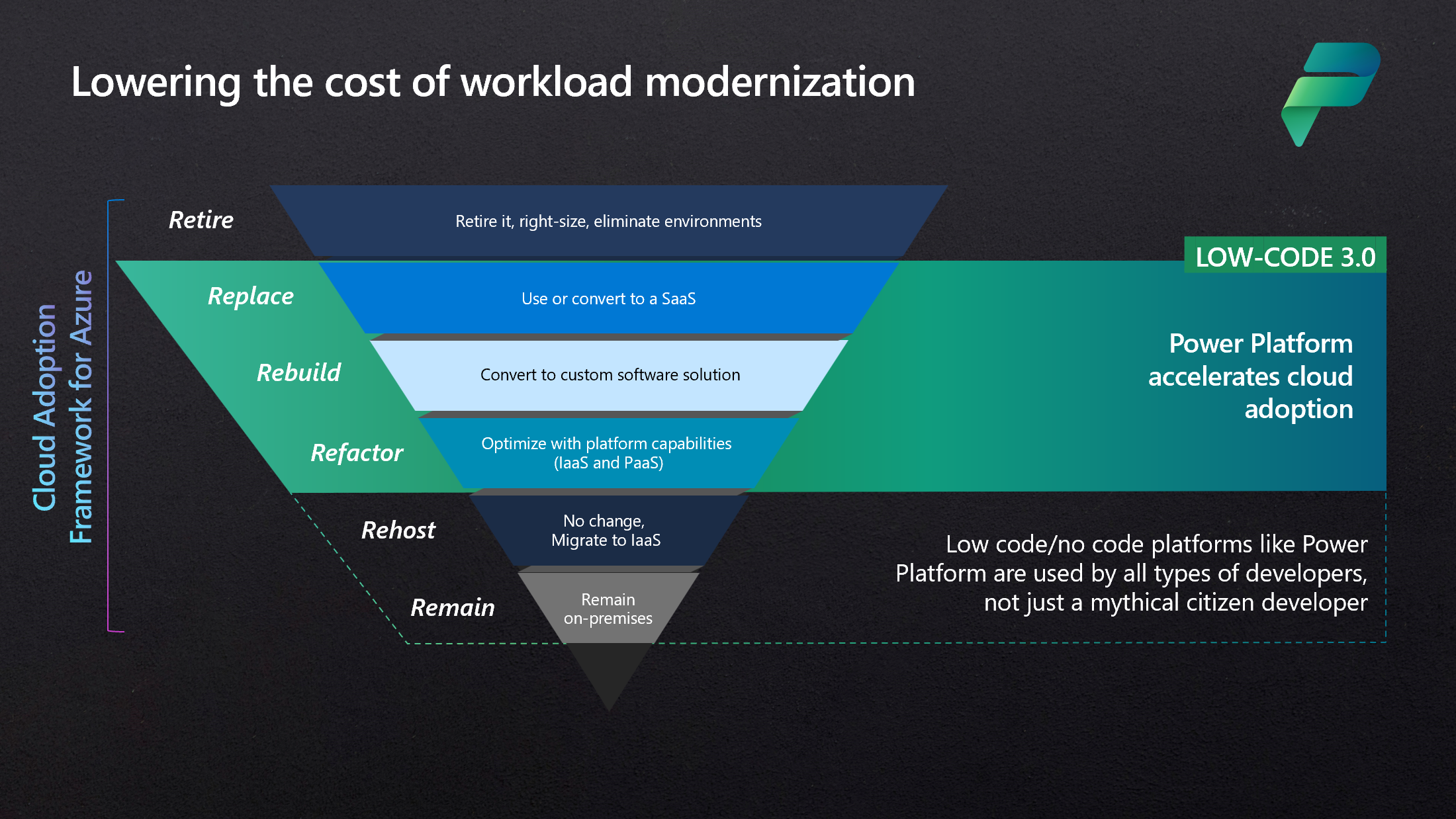
Let´s shortly recap and bring us top of mind on Cloud Adoption Framework using above visual. There´re six categories within and three of them today are an immediate fit for being addressed with Low Code 3.0 or Power Platform in addition to traditional coding tools – Replace, Rebuild or Refactor. In addition two further categories with Rehost and Remain being addressed with Power Platform in an indirect way, such as connecting to these assets via the Connectors Framework or the on-premises data gateway service.
Company´s CIO and CDO asking how to use this framework and do more with less in an uncertain and challenging time driving and accelerating digital- and workforce transformation projects? While being a fit for assessing current app or process landscape for possible (cloud) migration, there´s more to this framework when taken into account an orchestrated low code platform, such as Power Platform. To outline this aspect, let me share another visual used in customer conversation.

Above visual starts at the top right by showing a bunch of use-cases that are kind of „x-rayed“ with the Cloud Adoption Framework – visualized by the boxes being opened and taking a look of what´s insight to assess on how to proceed. Let´s consider a company with around 15.000 use cases them assessing that way. Now, given Gartner´s prediction of 70% of new applications being developed with Low Code, there´s a potential of 10.500 use cases being transformed with the help of Low Code. No big deal, you think so far. Well, going deeper in studies of recent app and process modernization projects there´s an average of 55 percent that could be taken into account for true rebuilding, which is roughly 5.775 potential use cases.
Doesn´t that sound like an impressive number to you? A third of all use-cases being transformed with the help of low code?
Well you may challenge there´s a price to it, cause migrating the software with traditional tools is less expensive. That´s a myth!
In a recent study, Forrester outlined 55% productivity increase by lowering access barriers to data to gather insights while remaining on high security standards. And they also highlighted a 45% decrease in application development costs. The magic „glue“ or motion to this is called out as Fusion Development. Overall, using Cloud Adoption Framework with its six categories is no longer an Azure only framework. Power Platform build on top of Azure recently became an important part of it and CIO and IT leaders across the globe are lowering their IT costs while driving and accelerating Hyperautomation with the combination of both professional- and citizen-developers.
What are the concrete benefits?
The Business Domain Experts being involved in the cloud transformation process can be seen in three motions.
- Augmenting existing software
- Prototyping new ideas
- Co-building applications or optimize business processes
Using Frameworks like Cloud Adoption Framework for assessing the maturity level of their application and process landscape first and being aware of using all kind of orchestrated developer tools as a platform, generates measurable outcomes, such as:
- Fusion Development first, when considering application modernization and process optimization
- Lower migration project timeline by enhancing developer capacity through including business side of the house
- Increasing employees satisfaction by participating actively in digital- and workforce transformation projects
- Make best of use out of Azure and other Cloud services and increasing the innovation factor by including those technologies, such as democratized access on AI/ML models
- Add additional life-span to existing on-premises landscape by allowing secured access to these (siloed) data sources
- Increase overall agility to react on changes incoming or disrupting and forcing a re-thinking
Customers around the world have been following frameworks to significantly lower the effort and time spent on theoretical thinking. Introducing principles and standards to invest back time won to focus on the „hard“ parts. MyPOV: We will see more and more Fusion development happening across the globe, not teach everyone to become a developer. Instead to do more with less.
What are your recent touchpoints with Cloud Adoption Framework or Fusion Development? Let me know in the comments. Until then, …
*This post is locked for comments