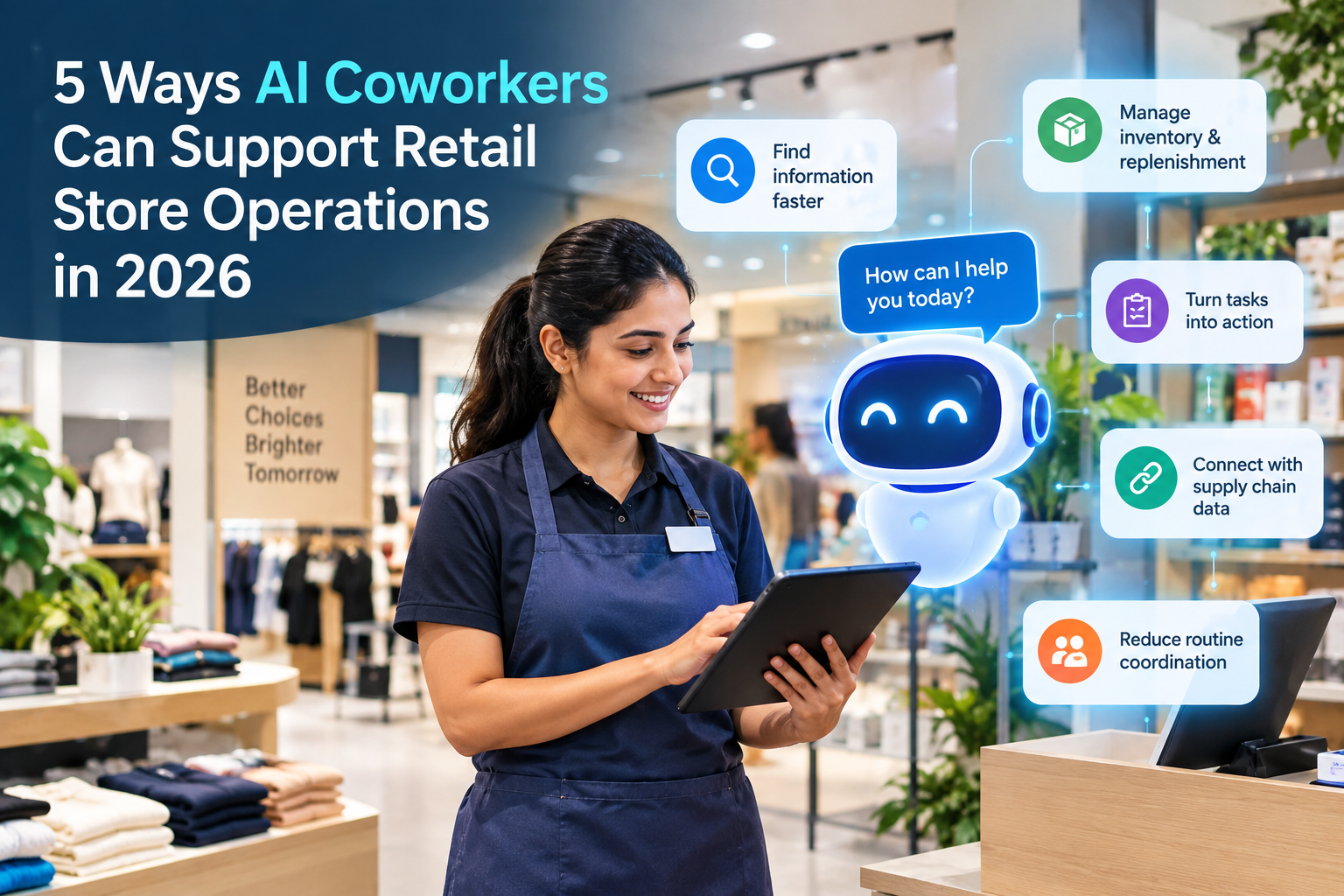
Retail store operations are becoming increasingly connected. Store associates may need to answer customer questions, check product availability, manage daily tasks, handle incidents, and coordinate with warehouse or supply chain teams, often while serving customers at the same time.
At the same time, retailers are dealing with changing customer demand, complex inventory networks, and pressure to operate efficiently. These are some of the inventory-management-challenges that can make day-to-day store operations more difficult.
AI coworkers and AI agents are emerging as a practical way to support employees with information gathering, routine tasks, and operational decisions. Rather than replacing store teams, these tools can work alongside employees and help them spend less time searching for information and more time serving customers.
Here are five ways AI coworkers can support retail store operations in 2026.
1. Help Store Associates Find Information Faster
Store employees regularly need access to product information, company policies, customer orders, and operational procedures.
An AI coworker can provide a conversational way to retrieve relevant information without requiring employees to search through multiple documents or applications.
For example, an associate helping a customer could ask an AI assistant about a product's specifications or availability. Microsoft describes retail scenarios where AI agents can help associates find product information and access customer order details during their work.
This can be particularly useful in busy stores where employees need answers quickly while remaining focused on customers.
2. Support Inventory and Replenishment Decisions
Inventory is one of the most important areas for retail operations. Having too little stock can affect product availability, while carrying unnecessary inventory can increase storage and carrying costs.
AI can help teams analyze inventory and demand information and identify areas that may require attention.
For retailers exploring Dynamics 365 Finance & SCM for retail, supply chain and inventory capabilities can provide a foundation for connecting inventory information with planning and replenishment processes. Microsoft highlights AI-supported demand planning, inventory optimization, and replenishment capabilities within Dynamics 365 Supply Chain Management.
An AI coworker can help employees interpret this information and surface relevant actions instead of requiring them to manually review multiple data points.
3. Turn Store Tasks into Actionable Work
Store operations involve many recurring tasks, from preparing displays to checking equipment and completing operational activities.
AI coworkers can help employees create, organize, and assign tasks using natural-language interactions.
For example, if an employee identifies damaged equipment while preparing a promotional display, an AI assistant could help create an incident or maintenance task and route it to the appropriate person.
Microsoft's retail store operations scenarios include AI-assisted task management and incident-ticket creation, allowing associates to handle these activities through a conversational experience.
The benefit is not simply automation. It is reducing the number of steps employees need to take to move an issue from identification to resolution.
4. Connect Store Operations with Supply Chain Information
A store does not operate independently from the wider retail supply chain. Product availability can depend on purchasing, warehouse inventory, deliveries, replenishment, and demand.
AI coworkers can help bridge some of these information gaps by bringing relevant business information into the employee's workflow.
For example, a store manager could ask about the status of an expected replenishment order or review information about available inventory before deciding how to respond to a customer request.
Microsoft's current retail strategy emphasizes connecting store operations with supply chain, inventory, and enterprise data, while Dynamics 365 Supply Chain Management provides capabilities across planning, procurement, warehouse management, and fulfillment.
This type of connected information can be especially useful for retailers managing multiple stores and distribution locations.
5. Reduce Time Spent on Routine Coordination
Retail employees often spend time moving between applications, checking records, communicating with other teams, and gathering information before completing a task.
AI coworkers can help coordinate some of these activities through a single conversational interface.
Microsoft's Copilot Cowork capabilities for Dynamics 365 ERP are designed to orchestrate information and workflows across ERP data, documents, email, spreadsheets, and collaboration tools, while keeping people involved in decisions and actions.
For retail teams, this can create a more streamlined way to handle operational questions and routine workflows.
Where AI Coworkers Fit into Retail Operations
AI coworkers are most useful when they support clearly defined business processes and have access to reliable information.
Retailers should not treat AI as a replacement for store employees. Human judgment remains important for customer interactions, exceptions, operational decisions, and business policies.
Instead, AI can take on supporting activities such as:
Finding information
Summarizing operational data
Identifying tasks that need attention
Supporting inventory reviews
Coordinating routine workflows
Helping employees navigate business processes
This human-and-AI approach allows employees to remain responsible for decisions while using AI to reduce repetitive work.
Preparing for AI-Enabled Store Operations
Before introducing AI coworkers, retailers should review the systems and data that support their store operations.
Important considerations include:
Data Quality
AI outputs depend on the information available to the system. Product, inventory, customer, supplier, and operational data should be accurate and appropriately maintained.
Process Integration
AI becomes more useful when it can work with the systems employees already use. Connecting ERP, inventory, warehouse, and collaboration tools can reduce information gaps.
Security and Permissions
Retailers should establish appropriate access controls so AI tools only work with information and actions that users are authorized to access.
Human Oversight
AI-generated recommendations should be reviewed according to the risk and importance of the task. Microsoft also emphasizes keeping humans in the loop for agentic workflows involving business actions.
Conclusion
AI coworkers can provide practical support for retail store operations by helping employees find information, manage tasks, understand inventory, coordinate with supply chain teams, and reduce repetitive administrative work.
For retailers facing growing operational complexity and inventory-management-challenges, connecting AI with business systems can provide a more useful foundation than treating AI as a standalone tool.
Solutions such as Dynamics 365 Finance & SCM for retail can provide the underlying supply chain, inventory, procurement, and warehouse capabilities that AI-driven workflows can build upon. The most effective approach is to start with specific operational problems, reliable data, clear processes, and appropriate human oversight.
Explore how DynamicsSmartz can support your retail business with Dynamics 365 solutions.


