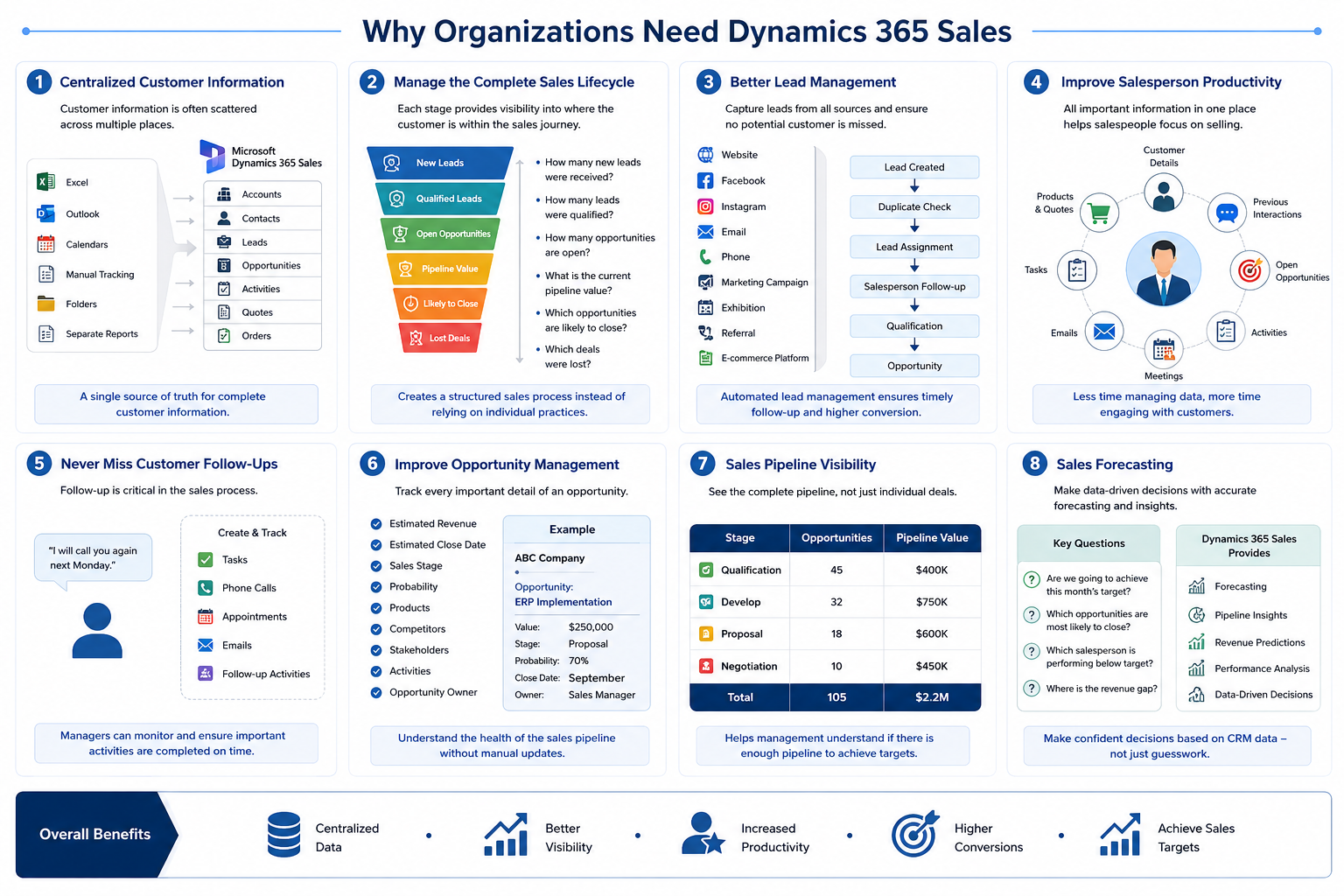
1. Centralized Customer Information
One of the biggest challenges organizations face is that customer information is distributed
across multiple places.
For example:
• Customer information in Excel
• Sales communication in Outlook
• Follow-ups in personal calendars
• Opportunities tracked manually
• Quotations stored in folders
• Sales reports maintained separately
This makes it difficult for management to get a complete picture of the customer.
Dynamics 365 Sales provides a centralized platform for managing:
Accounts → Contacts → Leads → Opportunities → Activities → Quotes → Orders
This gives salespeople a single source of truth for customer information.
2. Manage the Complete Sales Lifecycle
A successful sales process requires clearly defined stages.
Each stage provides visibility into where the customer is within the sales journey.
For example, management can quickly determine:
• How many new leads were received?
• How many leads were qualified?
• How many opportunities are open?
• What is the current pipeline value?
• Which opportunities are likely to close?
• Which deals were lost?
This creates a structured sales process instead of relying on individual salesperson practices.
3. Better Lead Management
Without a CRM, leads can easily be lost.
A lead might come from:
• Website
• Facebook
• Instagram
• Email
• Phone
• Marketing campaign
• Exhibition
• Referral
• E-commerce platform
Dynamics 365 Sales allows organizations to capture these leads and assign them to the
appropriate sales representatives.
The process can be automated:
Lead Created
↓
Duplicate Check
↓
Lead Assignment
↓
Salesperson Follow-up
↓
Qualification
↓
Opportunity
This helps ensure that potential customers don't remain unattended.
4. Improve Salesperson Productivity
Salespeople spend a significant amount of time searching for information and manually
updating records.
Dynamics 365 Sales brings important information together in one place.
A salesperson can see:
• Customer details
• Previous interactions
• Open opportunities
• Activities
• Meetings
• Emails
• Tasks
• Products
• Quotes
• Next actions
This allows the salesperson to spend more time engaging with customers and selling, rather
than managing spreadsheets.
5. Never Miss Customer Follow-Ups
Follow-up is one of the most important parts of sales.
A salesperson may speak to a customer today and promise:
"I will call you again next Monday."
Without proper tracking, this follow-up can easily be forgotten.
Dynamics 365 allows salespeople to create:
• Tasks
• Phone calls
• Appointments
• Emails
• Follow-up activities
Managers can also monitor whether important activities are being completed.
6. Improve Opportunity Management
An opportunity represents a potential sales deal.
Dynamics 365 Sales allows organizations to track important information such as:
• Estimated revenue
• Estimated close date
• Sales stage
• Probability
• Products
• Competitors
• Stakeholders
• Activities
• Opportunity owner
For example:
ABC Company
│
└── Opportunity: ERP Implementation
│
├── Value: $250,000
├── Stage: Proposal
├── Probability: 70%
├── Close Date: September
└── Owner: Sales Manager
Management can therefore understand the health of the sales pipeline without asking every
salesperson for a manual update.
7. Sales Pipeline Visibility
One of the biggest benefits of Dynamics 365 Sales is pipeline visibility.
Instead of seeing only individual opportunities, managers can see the complete pipeline.
For example:
Stage Opportunities Pipeline Value
Qualification 45 $400K
Develop 32 $750K
Proposal 18 $600K
Negotiation 10 $450K
Total 105 $2.2M
This helps management understand whether there is enough pipeline to achieve the company's
sales target.
8. Sales Forecasting
Sales forecasting is another major reason organizations implement Dynamics 365 Sales.
Management needs answers to questions such as:
Are we going to achieve this month's target?
Which opportunities are most likely to close?
Which salesperson is performing below target?
Where is the revenue gap?
Dynamics 365 Sales can provide forecasting and pipeline insights that help sales managers
make informed decisions.
Instead of relying purely on:
"I think this deal will close."
Management can make decisions based on CRM data.


