Share
Share Report
 58
58Hello,
I have my own test environment for Dynamics 365 Finance & Operations running on VMware with a local SQL Server instance (on-premises, not Azure).
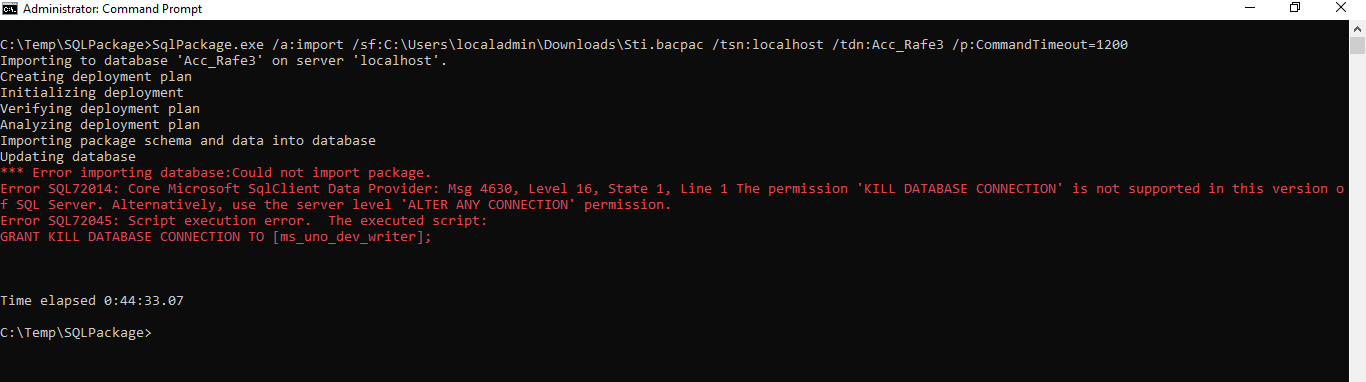
I download the database BACPAC backup file from the Asset Library in LCS and then restore it to my local SQL Server using the CMD command:
SqlPackage.exe /a:import /sf:C:\Users\localadmin\Downloads\DB_Name.bacpac /tsn:localhost /tdn:Acc_Name /p:CommandTimeout=1200
Where:
- **DB_NAme.bacpac** = the BACPAC backup file I downloaded from the Asset Library (represents the source database).
- **Acc_Name** = the name I want for the new database on my local SQL Server after restore.
- **DB_NAme.bacpac** = the BACPAC backup file I downloaded from the Asset Library (represents the source database).
- **Acc_Name** = the name I want for the new database on my local SQL Server after restore.
This process used to work fine, but recently I started getting the following error:
Error SQL72014: Core Microsoft SqlClient Data Provider: Msg 4630, Level 16, State 1, Line 1
The permission 'KILL DATABASE CONNECTION' is not supported in this version of SQL Server.
Alternatively, use the server level 'ALTER ANY CONNECTION' permission.
The permission 'KILL DATABASE CONNECTION' is not supported in this version of SQL Server.
Alternatively, use the server level 'ALTER ANY CONNECTION' permission.
Error SQL72045: Script execution error. The executed script:
GRANT KILL DATABASE CONNECTION TO [ms_uno_dev_writer];
GRANT KILL DATABASE CONNECTION TO [ms_uno_dev_writer];
It seems that the exported BACPAC from D365 now contains this permission, which is supported in Azure SQL but not in regular SQL Server (local on-premises).
Since my test environment is self-hosted on VMware, I cannot directly run it in Azure SQL for this import process.
My questions:
1. Is there a way to skip or ignore this permission during SqlPackage import?
2. Can I modify the BACPAC to remove this permission without breaking the checksum?
3. Is Microsoft aware of this recent change in exported D365 BACPAC files?
1. Is there a way to skip or ignore this permission during SqlPackage import?
2. Can I modify the BACPAC to remove this permission without breaking the checksum?
3. Is Microsoft aware of this recent change in exported D365 BACPAC files?
Any official guidance or workaround would be appreciated.
Thank you.
Categories:
I have the same question (0)
 All responses (
 Answers (