web
You’re offline. This is a read only version of the page.
close
Skip to main content

Announcements

News and Announcements icon
Community site session details

Community site session details

Session Id :
Small and medium business | Business Central, N...
Answered

Is there anyway I can readjust my unit cost in Navision 2018?

(0) ShareShare
ReportReport
Posted on by 5,085

Hi,

May I ask is there anyway I can readjust my unit cost in Navision 2018?

Thank you!

I have the same question (0)
  • Suggested answer
    Community Member Profile Picture
    on at

    Josh,

    Why? If you posted an incorrect Unit Cost for an Item it depends. Is the Invoice to the Vendor incorrect so you can do a Purchase Return Order and remove the Invoice and Item and then create a new PO and receive and invoice. If this is solely a Unit Cost mistake, you can use Revaluation Journal  to take the Item Ledger entry that is not correct and correct that specific Item Ledger Entry layer.

    Thanks,

    Steve

  • Suggested answer
    YUN ZHU Profile Picture
    101,995 Super User 2026 Season 1 on at

    Hi, as Steve said, you cannot adjust the unit cost of the posted documents in NAV, you need to create Credit Memo, and then create a new document.

    But If you want to appreciate or depreciate an item or a specific item ledger entry, you can use the revaluation journal.

    https://docs.microsoft.com/en-us/dynamics-nav-app/inventory-how-revalue-inventory

    Hope this will help.

    Thanks.

    ZHU

  • Suggested answer
    RockwithNav Profile Picture
    9,182 Super User 2026 Season 1 on at

    Use Revaluation Journal.

    docs.microsoft.com/.../inventory-how-revalue-inventory

  • joshtechsolutions Profile Picture
    5,085 on at

    Hi Steve,

    Actually, my purchasers were saying that in the business point of view, the Unit Cost shouldn't be change unless our suppliers tell us so. Otherwise, chances are the changes by the system will fall either below or above the actual price, even if its only 0.1 cents.

    If you look at it in bulk. 1 unit is 0.1 cents, 600 units will be around $60 loses to us.

    So on this point i'm not sure why Navision system will do this kind of calculation.

    If its due to Costing Method, which for my business we have selected FIFO, am I selected the wrong costing method?

    As you can see in the screenshot. The unit price is 23.25893, which is not the unit price we have inserted previously.

    Hence purchaser have to change the Direct Unit Cost Excl GST, which reflects here as $23.26.
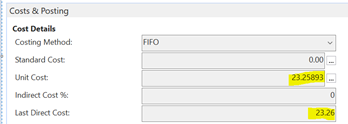
    pastedimage1631684691767v1.png

    Although in terms of figures, it is the same pretty much, but overall on the PO if it appear as $23.25893, it is incorrect.

    Please advise if possible.

    Thank you!

  • Verified answer
    Community Member Profile Picture
    on at

    Josh,

    Let me take a moment to explain the Unit Cost field in the Item Card and Last Direct Cost field.

    Last Direct Cost  -  Is the latest direct unit cost from the Direct Unit Cost field in the Purchase Line table when you post an order as invoiced. If you use journals, the program copies the direct unit cost from the Unit Amount field on item journal lines of the Purchase entry type.

    Unit Cost - We sometimes describe the Unit Cost on the Item Card as the “weighted average cost of the remaining inventory”. If we look at the Invoicing Tab on the Item Card, we see that the Unit Cost is 42.80.

    pastedimage1631716772840v3.png

    The question is, how did Dynamics NAV calculate that number? To understand how Microsoft Dynamics NAV calculates Unit Cost, one has to understand NAV’s Item Ledger Entries and NAV’s Value Entries. When an inventory transaction is recorded in NAV, an Item Ledger Entry and an associated Value Entry are automatically entered into the NAV database. The Value Entry reflects the cost of that transaction, whether positive or negative. Additional Value Entries may later be added by adding an Item Charge or the adjust cost program.  Dynamics NAV calculates the unit cost by finding the Value Entries for the item and then adds up the Cost Amount (Expected) and Cost Amount (Actual) to get the total cost. It then adds up the Item ledger Entry Quantity and then divides the total of the costs by the total of the Item Ledger Entry Quantity to get the Unit Cost. 

    pastedimage1631716709810v2.png

    The Unit Cost is the sum of the cost amounts divided by the total of the Item Ledger Entry Quantity

    On last thing, an item’s unit cost is the actual value of any receipt of the item, selected by the FIFO rule. In inventory valuation, it is assumed that the first items placed in inventory are sold first.

    I do not see an issue overall but I hope the above give you and your finance team more information.

    Thanks,

    Steve

Under review

Thank you for your reply! To ensure a great experience for everyone, your content is awaiting approval by our Community Managers. Please check back later.

Helpful resources

Quick Links

Season of Sharing Community Challenge Launch!

Jump in, show your community spirit, and win prizes!

Women in Power Builds Momentum

Expanding mentorship, skilling, and AI innovation

Congratulations to the May Top 10 Community Leaders

These are the community rock stars!

Leaderboard > Small and medium business | Business Central, NAV, RMS

#1
OussamaSabbouh Profile Picture

OussamaSabbouh 2,222 Super User 2026 Season 1

#2
YUN ZHU Profile Picture

YUN ZHU 1,603 Super User 2026 Season 1

#3
Grigorios Mavrogeorgis Profile Picture

Grigorios Mavrogeorgis 1,186 Super User 2026 Season 1

Last 30 days Overall leaderboard

Featured topics

Microsoft Training Manuals

Product updates

Dynamics 365 release plans



