Hello again,
Those are practically smart and interesting questions, I will try to tackle through them one by one as brief as possible.
Answer for Question (1)
This is the system behavior in order to make sure that the unit cost for the base unit of measurement is recorded precisely without any rounding variances. To explain this, allow me to provide the following example:
Suppose that you are receiving a case of Item A (case includes 6 pieces), which cost is 50, when you enter the receiving you include the cost of the "Case", although, the system will calculate the unit cost of the smallest unit of measurement in order to create a cost layer accordingly.
to calculate the cost of the smallest unit of measurement (piece), you need to divide the unit cost by 6 (since case include 6 pieces), >>> 50/6 = 8.3333333333 , how do you expect the system to handle rounding ?
To handle such situation, the system splits the quantity into two layers (one layer with 1 and the other with 5), and the rounding difference is recorded under the cost layer with the (1) quantity as follows:
- First Layer Cost: Round(8.3333333333,2) = 8.33
- Second Layer Cost: Total Cost (50) - [ Rounded First Layer Cost (8.33) * First Layer Quantity (5)] = 8.35
(5 * 8.33) + (1 * 8.35) = 50
You may check a blog post I have written long time ago on understanding this behavior, Unit Cost and Currency Decimals Setup
I will answer Question (3) since it is inventory related as well;
This cane be retrieved from the historical inventory trial balance report (Reports > Inventory > Activity > Historical Inventory Trial Balance). On this report, there is a parameter for the "date", include the date as of the historical period you want to get.
If you want to create a crystal report or excel-based report, you may check the SQL script posted on my blog under HITB Per Period (Cumulative) – Inventory Balance on a Prior Date
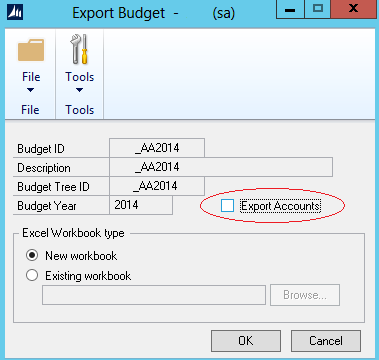
As for Question (2), you need to check the "export account" checkbox when exporting the analytical accounting budget as shown in the screen shot below:
Your feedback is highly appreciated,


