web
You’re offline. This is a read only version of the page.
close
Skip to main content

Announcements

News and Announcements icon
Community site session details

Community site session details

Session Id :
Small and medium business | Business Central, N...
Suggested Answer

column layout formula

(0) ShareShare
ReportReport
Posted on by

I've been struggling with accounts schedules in NAV 2009. I've read some instructions in order to get the comparison period formula column, field 14 in the column layout table. Is this available to add in all versions of 2009 or is it possible that this is not an option in some versions and you only have comparison date formula?

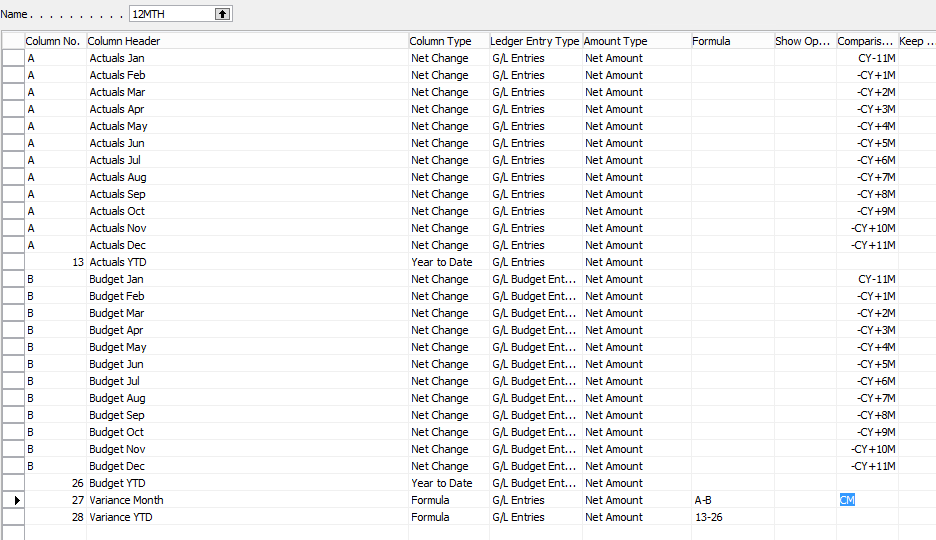
As I only have comparison date formula for now, I've been having issues in creating a column layout which gives 12 months actuals including YTD and 12 months budget including YTD. I have managed to find formula to give each month but don't know how to get a current month variance for actuals v budget. Any idea?
pastedimage1595858955974v1.png

I have the same question (0)
  • ManishS Profile Picture
    86 on at

    Variance for which month you are looking at, what does variance A-B represents to.

    You need to Enter Column No. A1,A2 and so on till 12 for actuals & for Budget entries B1,B2 and so on.

    Now in your Column No. 27 enter A1+A2 till A12 minus B1+B2 till B12 to get the variance.

  • Suggested answer
    CarmenNunes Profile Picture
    Microsoft Employee on at

    Hello Simone,

    Not sure if is this what you are looking for, but you can add some additional Columns Lines to have the Average % between Real Entries and Budget.

    Here is a sample of Column Layout

    pastedimage1595867986524v4.png

    and the result that you can get when running account schedule for a range of dates

    pastedimage1595867939868v3.png

    Hope  this can help you.

  • Community Member Profile Picture
    on at

    Hi Manish, thanks so much for response. Your suggestion on variance only works for the month of January then the variance becomes the same as YTD. Any other ideas?

    I'm just trying to get 12 month columns for actuals with a YTD, then 12 month columns for budget with YTD, then a current month variance column and a YTD variance column. I get everything to work apart from the current month variance

  • Community Member Profile Picture
    on at

    Hi Carmen, I'm trying to get 12 month columns for actuals with a YTD, then 12 month columns for budget with YTD, then a current month variance column and a YTD variance column. I get everything to work apart from the current month variance. Your example looks like a YTD example

  • Suggested answer
    CarmenNunes Profile Picture
    Microsoft Employee on at

    Hi Simone,

    That's true my sample is YTD but also depends the date filter we use for it.

    I was just trying to show how you can add some additional  column to get average %  between both amounts.

    I will try to repro a similar case as yours.

  • Community Member Profile Picture
    on at

    Hi Carmen

    That would be really helpful. Even just for 3 separate months as I'm at a loss!

  • Suggested answer
    CarmenNunes Profile Picture
    Microsoft Employee on at

    Hi Simone,

    I just take a look in previous Manish suggestion and in fact it should work if you define different codes for each columns GL Entries and GL Budget Entries instead using always "A" and "B".

    Then you have to add an additional line to get the difference between those lines without entering a comparison Date formula.

    Hope this can help  you.

  • Community Member Profile Picture
    on at

    thanks for your response Carmen but can you check my attached column layout and let me know how to amend to get it to work. Its the highlighted line that doesn't work - how to get the actuals v budget variance for the month so If I view my account schedule at 30th Jul then I get the variance for that month and I also get the YTD variance in another column

    pastedimage1596620109516v1.png

  • ManishS Profile Picture
    86 on at

    A1-B1 means the difference will be shown for only Jan Month.

  • Suggested answer
    ManishS Profile Picture
    86 on at

    This is what you need to do for getting variance for each month.

    New-Bitmap-Image.jpg

Under review

Thank you for your reply! To ensure a great experience for everyone, your content is awaiting approval by our Community Managers. Please check back later.

Helpful resources

Quick Links

Season of Sharing Community Challenge Launch!

Jump in, show your community spirit, and win prizes!

Women in Power Builds Momentum

Expanding mentorship, skilling, and AI innovation

Congratulations to the May Top 10 Community Leaders

These are the community rock stars!

Leaderboard > Small and medium business | Business Central, NAV, RMS

#1
OussamaSabbouh Profile Picture

OussamaSabbouh 1,687 Super User 2026 Season 1

#2
YUN ZHU Profile Picture

YUN ZHU 1,041 Super User 2026 Season 1

#3
Grigorios Mavrogeorgis Profile Picture

Grigorios Mavrogeorgis 974 Super User 2026 Season 1

Last 30 days Overall leaderboard

Featured topics

Microsoft Training Manuals

Product updates

Dynamics 365 release plans



