




 2,085
2,085 Like
Like Share
Share
 Report
It is truly an interesting time we´re walking through with low-code enabling more and more Business Technologists across industries. From recovering business on pandemic caused issues, through uncertain times introduced by supply-chain challenges due to war situation in Ukraine, to adopting a new way of work: Going hybrid. Today, I´d like to share how low-code enabled a manufacturer to find solutions to evolving challenges.
Challenges, that mind sound familiar for many manufacturer, executing industry 4.0 strategy, transforming their business models in terms of sustainability, success and future employees and customer demand. Investing into their Smart Factory strategy while new challenges needs to be applied, many of them asking: How could this be applied in times of increasing pressure?

Interviewing employees at the shop floor level on how digital transformation helped them achieving their personal goals while matching company given performance indicators, I was shared some interesting insights. From reservations like Why someone working at that shop floor would transform being a Business Technologist? (By the way, if you want to learn more about this term, check out an article I published back in March) To why companies still growing IT backlog by only requesting business demand and requirements on digital apps and processes to execute Digital Workplace strategy.
Not yet or fully including them in a Fusion Development strategy setup and therefore continue struggling with the lack of available developers and decreasing the IT Backlog.
Buzzwords like LCAP (Low-code application platforms), RPA (Robotic process automation), Digital Workplace, or latest Hyperautomation still seem far away from Front-line workers when asking employees to describe their day-to-day job. Though it´s time CDO´s and CIO´s to rethink the Digital Workplace.
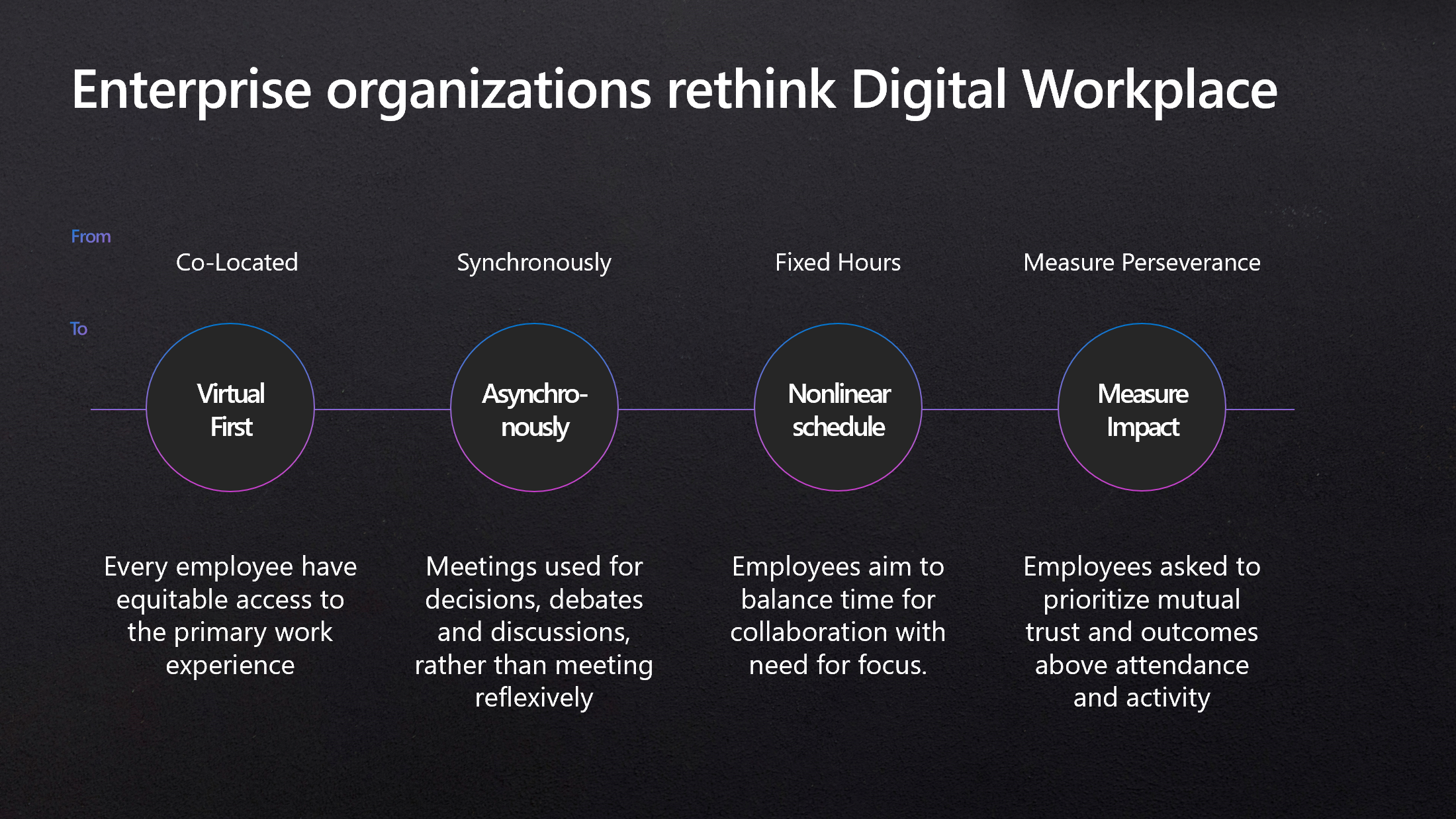
Above visual outlines some of the strategies to do so, starting by thinking Visual First and working in Asynchronous teams. Turning from Fixed Hours into a business model of Nonlinear schedule and changing measurement in terms of putting impact first. Those changes to implement, causing to revisit the Smart Factory architecture that was designed during Industry 4.0 adoption. Putting the employee first to unleash use-cases that failed in digital transformation, were poorly designed without taking into account the user experience or missed adoption because of only partly meeting requirements or changes introduced by external factors.

When talking to the CIO and CDO of a manufacturer, together we revisited their Smart Factory house earlier designed to adapt Industry 4.0 standards and drive digital transformation. With the insights won based on interviewing the first-line workers and department leaders, we modified the architecture to include new solutions based on low-code tools used inside the Intelligent Operations Platform that can be adopted by, build and deployed by Business Technologists. Furthermore, we went through additional components and based on feedback collected, we mapped Power Platform (low-code) to be a good fit for closing further white-spot areas identified.
And after allowing some additional time to reflect and review, we even went through Gartner´s definition of Hyperautomation and came up with an umbrella to span all components of the Smart Factory architecture. All to continue enabling employees, increasing collaboration across teams and boost agility insight company, but remain safe by using the strength of an orchestrated platform that lowers maintenance efforts around Governance, security and identity management while dealing with trust management. This manufacturer revisits their strategy and execution plan more frequently than before and implemented key performance indicators to measure success on executing the implementation of this architecture – thanks to their earlier applied and executed Center of Excellence strategy. Of course, I am not allowed to share details here or mention names, but my conclusion is: It´s about time to rethink and revisit. What´s about your story and strategy? Until then,…
*This post is locked for comments