




 2,085
2,085 Like
Like Share
Share
 Report
When it comes to application development or modernization of legacy apps with low-code, specifically when driven by Citizen Developers, or as I like to call them – Business Technologists, often times there´s the question in the room about business value assessment. Those rapidly created apps, some tend to call them out as „crap“ as they haven´t yet understood that low-code is to empower everyone. So wether an app is crap or not isn´t about the Creator. Back in 2021, I´ve already written an article around this. But today, I wanted to revisit this topic based on a recent conversation I had. A customer asking me, if I would be familiar with the 4Rs from Gartner as a strategy for cost optimization.

So we started our conversation with above visual. First, by aligning on the influencing factors surrounding and driving the need of continuous thinking about a cost optimization strategy in general. I then asked him around the 4Rs to be in-sync with them and I got the following as a result (also found in the inner area of above visual):
- Reduction
- Replacement
- Rethinking
- Reinvesting
Making an invest into Power Platform from a Microsoft 365 perspective already, but then starting to boost innovation by reinvesting into premium or standalone licensing to ensure usage of all features available in Power Platform. Some customers still struggling with this approach.

I therefore enriched our conversation with the above visual showing a typical adoption journey of a Power Platform customer and outlining why there could be a struggle with the investment in features and capabilities. I shared with them in terms of Change Management they might started their journey with being confident about what kind of use-cases to be selected for low-code development. I challenged on the orchestration of the platform in terms of stepping outside the comfort-zone and introducing an Environment strategy, which takes into account that the Default environment is not the „container“ for storing all kind of business use-csaes. I asked about a quick maturity level assessment on their Maker community and we finally talked about the business cases and possible business value assessments.
While doing so, we obviously needed to catch-up first on how they were going to select their use-cases and decide on tools to develop or deploy them to production. Many times, it´s Makers having an idea that runs through an ideation & creation process first, to ensure that all DevOps tasks are in sync with the idea of the Maker. Especially, if those ideas end-up in being business critical use-cases and not just for personal productivity. We kind of assessed from a „runners“ perspective, if them operating in a Ready, Set, Go or even Boost scope already.
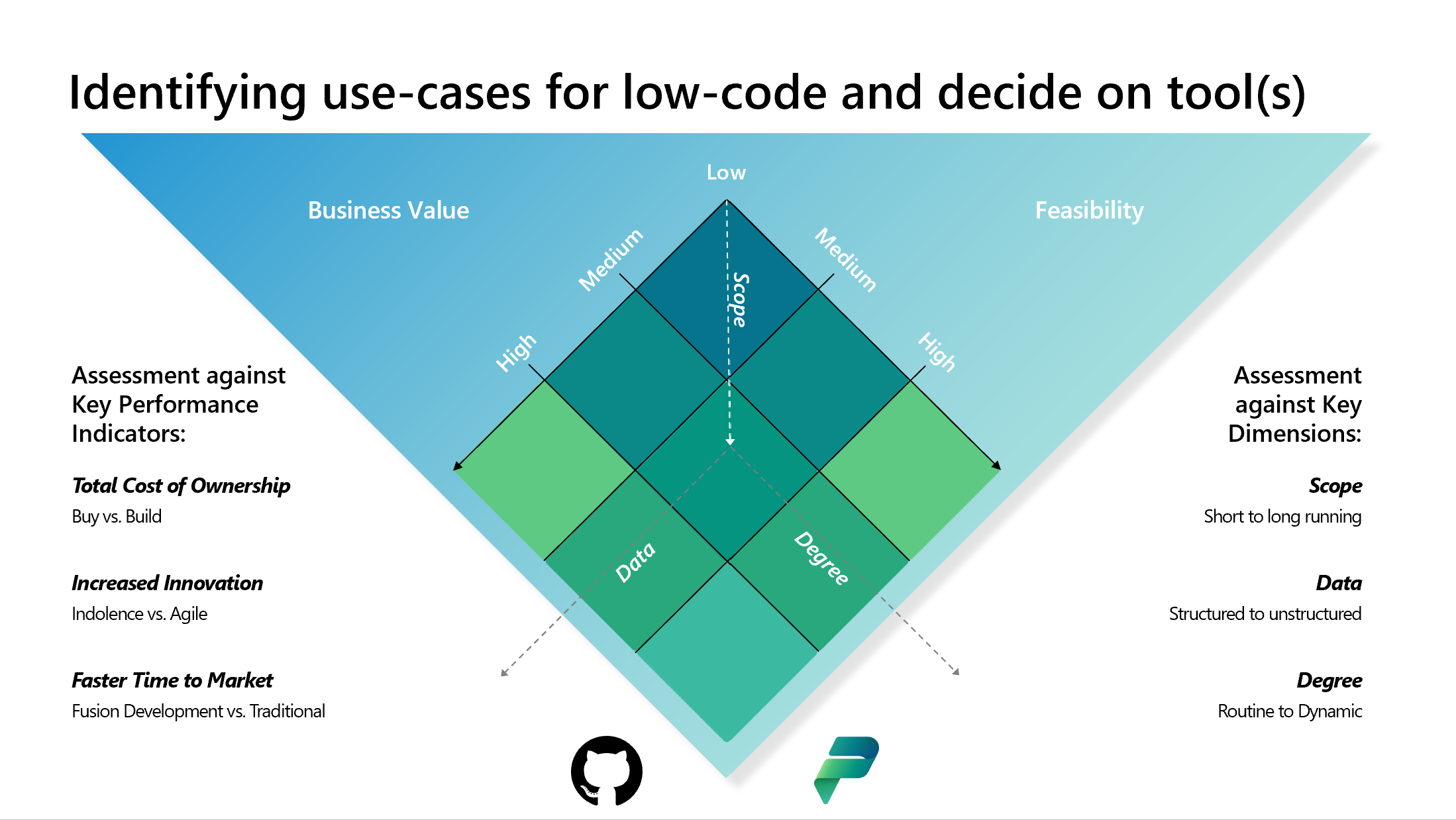
Discussing about the 4Rs shown earlier, I showed above visual and asked the customer, if they would be using a methodology like this, which would ensure to assess the use cases from two different angles. If asking, why I selected this visual – it´s coming from Gartner as well, and I was considering based on the customer challenging me with some Gartner stuff, that they consider to follow Gartner´s best practices. This triangle between Outcome, Business Value and Feasibility starting by using a simple to understand matrix for running various assessments with. On tools to be used by Creators or
On Key Dimensions
This would be to first identify if the scope of the use-case is either short or long-term running. Data included or needed for this use-case either being unstructured or structured. And the scenario being either very dynamic and constantly changing or an automation of a typical routine or repetitive task or bundle of actions.
On Key Performance Indicators
The third part would allow them to assess their use-case catalog against Key Performance Indicators (KPIs), such as the TCO from a buy vs. build perspective, or the Faster time to Market and Value, due to their development process taking into account the strengths of Fusion Development teams vs. traditional software development. And of course, let´s not forget about the Innovation factor.
Conclusion
We came to the conclusion that the importance of a good ideation and creation process, incl. an inventory management with for instance having a use-case catalog, is part of a good business value assessment strategy. Not having those instances, would make it a lot more effort to run business value assessments internally, as well as deciding on which use cases to take into account for this.
As said earlier, there´re tons of personal- or teams productivity use-cases out there, where only one or a small group of employees gets empowered by a rethought process supported with Power Platform tools. But is it worth to estimate all kind of KPIs for this if the key dimension for instance is a short scale or lifetime? Should you care from a business value, or just let it run and assume that the mass of all those use-cases add enough business value in general?
We couldn´t end our discussion by obviously taking a closer look at the big trend surrounding a reinvest into Power Platform – Generative AI.

We used above visual to further discuss the various Copilot announcements and benefits any Maker, Creator, Business Technologist or Developer would have by reinvesting into Power Platform – considering the usage of standalone or premium licenses and being able to use created artifacts from run-time experience. Why run-time experience?
Well most of the Creators these days are equipped with the Developer Plan license that allows them to create artifacts at No cliffs. They decide on best technology to be used for enabling their use-cases rapidly, creating faster time to market and value and being more agile in terms of including a change management, as requirements might vary over the run-time or application lifecylce.
Having that flexibility compared to making a decision case-by-case obviously can be easier done by having a couple of use-cases identified to run business value assessements for. Who doesn´t like to have a comparison of investment vs. pay-out these days? And circling back on all the influencing factors that makes an impact on the 4Rs, while any of those should be part of a cost-optimization strategy, it´s about adding the low-code orchestrated platform and Fusion Development teams factor to a future ready IT & Developers strategy.
Generative AI will make it even easier for any developers to rapidly modernize legacy applications or create brand-new applications and processes. Think of a non-COBOL skilled Creator who got asked to transform some code into cloud-ready API. Why shouldn´t this person ask Generative AI to come-up with a solution, instead of learning the COBOL language in it´s fullness just for this replacement? (And yes, if you ask why I am using this example: I needed to learn COBOL just for passing one of my Masters)
Generative AI just started and we will see more capabilities added rapidly. In terms of Business Value Assessment and using my outlined approach to decide on low-code or code-first, tools next – at least this customer now feels more empowered after having this discussion. Let me know about your experiences with Business Value Assessment inside your company. Until then,…
*This post is locked for comments