web
You’re offline. This is a read only version of the page.
close
Skip to main content

Announcements

No record found.

News and Announcements icon
Community site session details

Community site session details

Session Id :
Finance | Project Operations, Human Resources, ...
Answered

Accounting entry for Fixed Asset Sale / Scrap

(0) ShareShare
ReportReport
Posted on by 2,334

Hello,

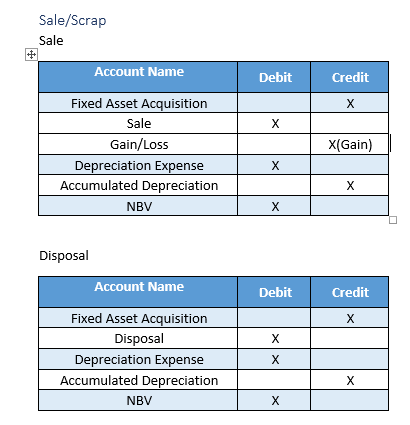
I was understanding the accounting entry for Fixed Asset Sale/Scrap. I am little confused. Here is my entry:
pastedimage1629601719351v1.png 

In case of Sale, Fixed Asset Acquisition - NBV = Sale +/- Gain Loss

In case of Disposal Fixed Asset Acquisition - NBV = Disposal

Is this correct understanding? Is this how the entry is created in D365 F&O when we sale or scrap a Fixed Asset?

I have the same question (0)
  • Suggested answer
    Ludwig Reinhard Profile Picture
    Microsoft Employee on at

    Hello MYGz,

    There are different possibilities how you can setup the ledger posting for fixed asset sales scrap.

    The examples that you shared above, are they from your company's setup, from the MS demo companies or from your accounting manual?

    Can you possibly describe the voucher that you expect to see?

    Many thanks,

    Ludwig

  • MYGz Profile Picture
    2,334 on at

    Hello Ludwig,

    The examples are generic in context of D365 F&O. Maybe you can throw some light on best practices in D365 F&O.

    I was writing sample accounting entry for Fixed Assets sale and Fixed Asset Scrap according to my understanding.

    Depreciation and Accumulated Depreciation will be reversed.

    The FA sale accounting entry equation will be: 

    Asset Acquisition - NBV = Sale +/- Gain Loss

    The FA disposal accounting entry equation will be:

    Asset Acquisition - NBV = Disposal (in case of disposal NBV = Disposal/Sale)


    Regards,

  • Verified answer
    Ludwig Reinhard Profile Picture
    Microsoft Employee on at

    Hi MYGz,

    In the MS Contoso demo companies you find a setup that reverses the previously recorded transactions on the depreciation and 'accumulated' accounts.

    This makes sense based on the setup that is made there and which records the asset values 'gross' on separate accounts; first on accumulated depreciation/revaluation/write up/write down / .... accounts in your balance sheet and second on P&L accounts in your Income Statement.

    That's one possibility how to record those transactions, which makes much sense if you have to report fixed asset and accounting values e.g. based on IFRS.

    Yet, you can also summarize the postings on single accounts that hold the acquisition and 'accumulated' amounts and make much simpler postings. Sometimes, smaller companies that have to follow local accounting standards prefer this setup because its easier.

    Hope this helps.

    Best regards,

    Ludwig

Under review

Thank you for your reply! To ensure a great experience for everyone, your content is awaiting approval by our Community Managers. Please check back later.

Helpful resources

Quick Links

Introducing the 2026 Season 1 community Super Users

Congratulations to our 2026 Super Stars!

Congratulations to our 2025 Community Spotlights

Thanks to all of our 2025 Community Spotlight stars!

Leaderboard > Finance | Project Operations, Human Resources, AX, GP, SL

#1
Giorgio Bonacorsi Profile Picture

Giorgio Bonacorsi 617

#2
André Arnaud de Calavon Profile Picture

André Arnaud de Cal... 461 Super User 2026 Season 1

#3
Syed Haris Shah Profile Picture

Syed Haris Shah 298 Super User 2026 Season 1

Last 30 days Overall leaderboard

Product updates

Dynamics 365 release plans
